


For years, the go-to advice has been simple: Indicas are for relaxing your body, and sativas are for a more energetic, cerebral experience. The classic shorthand was that indica would leave you "in-da-couch," while sativa was your best bet for creative projects or a night out with friends.
It was a neat and tidy way to categorize things, but it turns out, it's not the whole story.
Debunking The Indica vs Sativa Myth
For decades, we all relied on the indica-sativa split. It was an easy framework that gave us a sense of control over our cannabis experience. If you wanted to unwind, you'd ask for an indica. Gearing up for a social event? A sativa was the obvious choice.
While those terms are still botanically correct for describing a plant's physical traits—like its height, leaf structure, or flowering time—we now know they are incredibly unreliable for predicting its effects. The old model just doesn't hold up to modern science.
The reality is that a strain's effects come down to its unique chemical profile. This profile is made up of two main groups of compounds:
- Cannabinoids: These are the famous molecules like THC and CBD that directly interact with your body’s endocannabinoid system.
- Terpenes: These are the aromatic oils behind the distinct smells of cannabis—from citrus and pine to floral and earthy notes. They don't just create the scent; they also play a massive role in shaping the overall experience.
The specific combination of cannabinoids and terpenes, now often called a product's "chemovar" (short for chemical variety), is what truly dictates your experience. It's entirely possible for a sativa to feel relaxing or for an indica to feel uplifting, all thanks to its unique chemical fingerprint.
Shifting Focus From Labels to Chemistry
Relying on those old-school labels can lead to some pretty confusing and inconsistent outcomes. Maybe you've already experienced this yourself—feeling surprisingly alert after trying an "indica" or ready for a nap after a "sativa." This isn't just you; it's a perfect example of why the old system is flawed.
To make choices you can count on, it’s time to look past the simple indica/sativa/hybrid categories. Focusing on a product's specific chemical makeup gives you a much clearer road map. By getting familiar with the key cannabinoids and terpenes, you empower yourself to find the exact effects you're looking for, time and time again.
To learn more about how these compounds work together, you can check out our guide on the power of whole-plant cannabis.
This is really a shift from folklore to science. The table below highlights the crucial differences between the traditional beliefs we're all used to and the modern, evidence-based reality of how cannabis actually works.
Traditional Labels vs Chemical Reality
| Aspect | Traditional Belief | Modern Scientific Understanding |
|---|---|---|
| Primary Predictor | Plant lineage (Indica or Sativa) | Chemical profile (cannabinoids and terpenes) |
| Indica Effects | Consistently relaxing, sedating, "body high." | Effects can vary widely; may be relaxing or uplifting depending on its specific chemical makeup. |
| Sativa Effects | Consistently energizing, uplifting, "head high." | Effects are not guaranteed; a product's terpene profile could result in relaxing sensations. |
| Consumer Guidance | "Choose indica to relax, sativa for energy." | "Choose based on desired effects and the product's specific cannabinoid and terpene content." |
Ultimately, understanding the "why" behind an effect is far more useful than relying on an outdated label. It’s all about the chemistry.
What Actually Defines Your Cannabis Experience
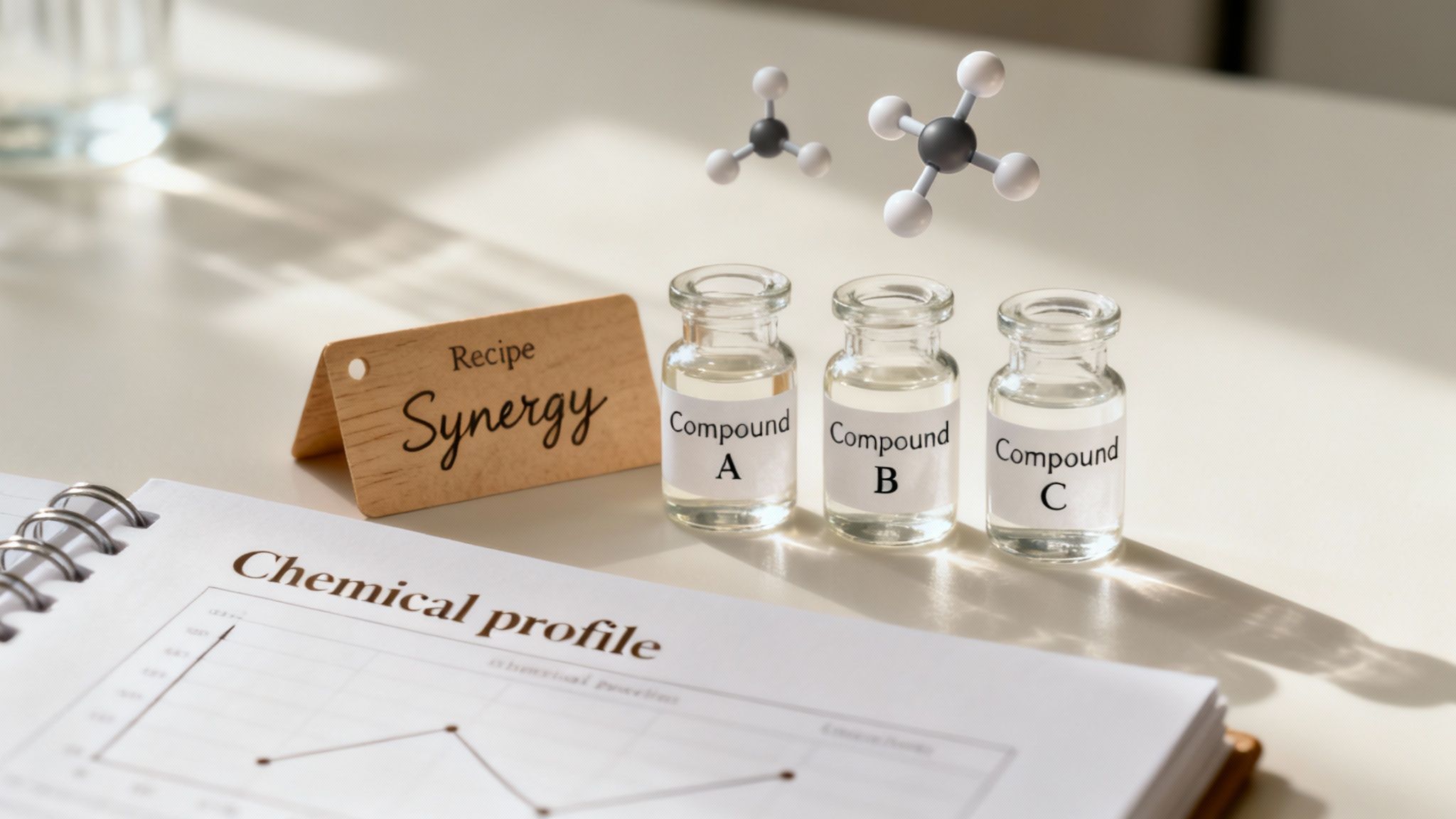
So if the indica and sativa labels are more folklore than fact, what should you be looking at? The real answer is in the plant’s unique chemical makeup. It's a lot like a bartender mixing a cocktail—the final drink isn’t defined by whether you call it a "tiki drink" or a "sour," but by the specific spirits, juices, and bitters inside.
When it comes to cannabis, the "ingredients" are natural compounds called cannabinoids and terpenes. Getting a handle on these two groups is the secret to finding the experience you want, far more reliably than just picking a team in the indica vs. sativa debate.
The Role of Cannabinoids
Cannabinoids are the primary compounds that make cannabis work. You’ve definitely heard of the big two, THC and CBD, but scientists have identified over a hundred others that all play a part in the final effect.
-
THC (Tetrahydrocannabinol): This is the famous one, the compound responsible for the euphoric "high" that most people associate with cannabis. Its concentration, shown as a percentage, is the most straightforward measure of a product's raw power.
-
CBD (Cannabidiol): As a non-intoxicating cannabinoid, CBD doesn't produce a high. Instead, it’s known to work alongside THC, often smoothing out the intensity and adding its own subtle properties to the mix. A product with both THC and CBD will feel completely different than one with just a high THC level.
But even the THC percentage only tells you how strong the experience might be, not what it will feel like. The character of the high—whether it’s uplifting, sedative, creative, or spacey—is shaped by another fascinating class of compounds.
The Influence of Terpenes
Terpenes are the fragrant oils that give different cannabis strains their unique aromas. That zesty lemon scent, the sharp smell of a pine forest, or a funky, earthy note? That’s all terpenes. These molecules are found all over the natural world, not just in cannabis.
More than just providing flavour, terpenes work in tandem with cannabinoids to steer the overall effects. This is the real reason why two strains with the exact same THC level can feel worlds apart.
This beautiful synergy between cannabinoids and terpenes is what we call the "entourage effect." The theory is simple: all the compounds in the plant work better together, with each one influencing the others to create a unique, well-rounded result.
A good way to think about it is like a band. THC might be the lead singer, but the terpenes are the rest of the musicians. That singer’s voice is crucial, but it's the guitarist, bassist, and drummer that determine whether the song is a blistering rock anthem or a mellow acoustic ballad.
Decoding Common Terpene Profiles
Learning to recognize just a few key terpenes will completely change how you shop for cannabis. You'll start to see these listed on product labels, and they are your best guide to the experience inside.
Here are some of the main players to look for:
-
Myrcene: The most common terpene in modern cannabis, myrcene has a musky, earthy aroma with a hint of fruit. It's the one most often linked to deeply calming and relaxing effects—think "couch-lock."
-
Limonene: Just like it sounds, this one brings a powerful citrus and lemon scent. Limonene is usually associated with an uplifting, energizing, and mood-boosting experience.
-
Pinene: With a sharp, fresh scent of pine needles, pinene is often connected to feelings of alertness, focus, and creativity.
-
Linalool: Best known for its floral, lavender-like aroma, linalool is the go-to terpene for tranquil and soothing sensations.
-
Caryophyllene: This terpene delivers a spicy, peppery kick, like black pepper or cloves. It’s unique because it's the only terpene known to act like a cannabinoid by interacting directly with our body's endocannabinoid system.
By shifting your focus from the simplistic indica vs. sativa effects to a product’s actual chemical profile—its chemovar—you empower yourself to make much better choices. Instead of just asking for an "indica," you can start asking for a product rich in myrcene and linalool for a relaxing evening, or one high in limonene and pinene for a creative afternoon.
Why Experts Are Moving Past The Indica vs. Sativa Model
For years, the indica vs. sativa model has been the go-to framework for cannabis users. It's simple, it's familiar, and it seems to make sense. But as we've learned more about the cannabis plant, a growing number of experts and researchers are arguing that this binary is an outdated and scientifically flimsy way to predict how a product will make you feel. The heart of the issue comes down to genetics—and the surprising lack of consistency within these old categories.
While the terms indica and sativa are still useful for growers to describe a plant’s physical traits—like its height and leaf shape—they completely fall apart when you try to use them to forecast an experience. The compounds that actually shape your high, the cannabinoids and terpenes, often have zero correlation with a plant's supposed indica or sativa heritage. This is why many in the know now see these labels as more of a marketing gimmick than a reliable guide.
The Genetic Proof That Unravels The Old Model
The whole "indicas relax, sativas energize" idea rests on a big assumption: that all plants in one category share a distinct genetic profile that produces those specific effects. Well, some groundbreaking research right here in Canada has shown that's just not true. This work has really put the final nail in the coffin for the old indica vs. sativa paradigm.
A major study from researchers at Dalhousie University and the University of British Columbia dealt a huge blow to the classification system. They took a deep dive into the genetics of 83 different THC-rich strains from licensed Canadian producers and found no consistent genetic pattern that could reliably sort them into indica or sativa buckets. You can read more about this surprising cannabis genetics research to get the full story.
Perhaps the most eye-opening discovery was that a Jamaican Lamb's Bread strain—a legendary variety marketed as 100% pure sativa—was genetically almost identical to a classic indica from Afghanistan. This one finding perfectly illustrates how misleading the labels can be.
This research scientifically confirms what many of us have found out through personal experience: a product’s effects don’t always line up with what the label says. It’s the specific chemical cocktail inside that flower, interacting with your unique body chemistry, that determines your high—not some broad, centuries-old classification.
Marketing Shorthand vs. Scientific Reality
So, if the science doesn't back it up, why is the cannabis industry still so attached to the indica-sativa divide? It really comes down to history and marketing convenience. For a long, long time, "indica" and "sativa" were the only words we had to talk about different kinds of cannabis.
This language became a handy shortcut for budtenders and customers to talk about the kind of experience they were looking for. Let's be honest, it's a lot easier to ask for a relaxing "indica" than to ask for a "strain with a terpene profile heavy in myrcene and linalool, with a moderate THC-to-CBD ratio."
Here's a quick rundown of why the terms stick around:
- It's Familiar: People have been taught this system for decades. It's what they know and what they ask for.
- It's Simple: It offers an easy-to-grasp (even if inaccurate) way to navigate a very complex product.
- Marketing Momentum: Countless brands have built their entire identity and product lines around these classifications.
While it makes sense from a business standpoint, sticking to these outdated terms can actually hold consumers back from finding what they truly want. A more accurate, science-based approach is the best way to make an informed choice. By shifting your focus from a simple label to a product’s detailed chemical profile (its chemovar), you empower yourself to find what actually works for your body and your goals. This is a lot like understanding how individual compounds work, something we cover in our article on unraveling the therapeutic potential of CBD.
Navigating Inconsistent Labels in The Market
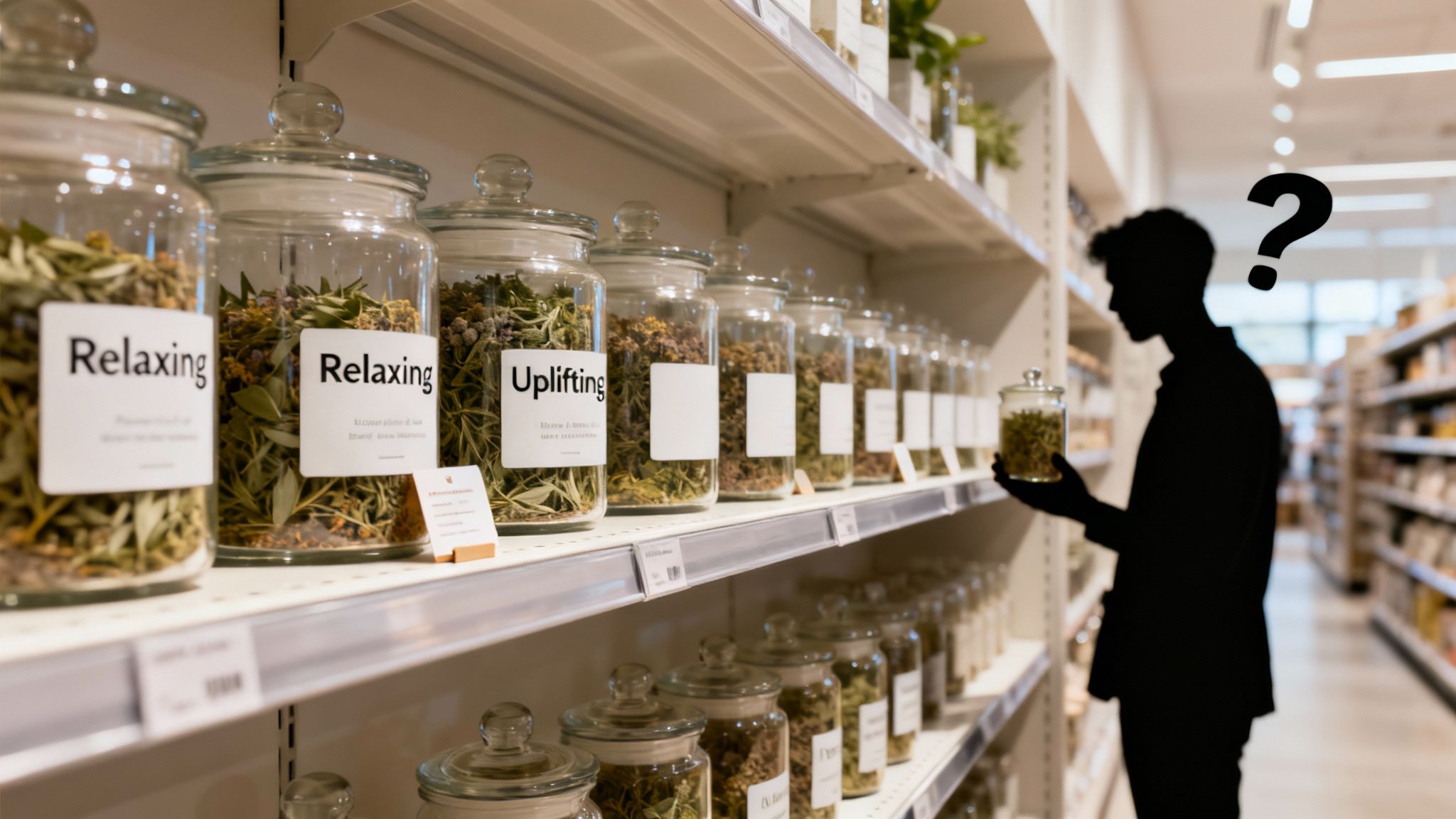
The moment you start exploring the cannabis market, you'll run into a confusing trend. Many shops and websites still lean heavily on the classic indica and sativa labels, pitching one as calming and the other as energizing. The problem is, this simple marketing often creates more questions than answers, leaving a lot of people scratching their heads about what they're actually buying.
This isn't just a local quirk—it's happening everywhere. It really shines a light on the gap between old-school marketing and what science tells us today. You might walk into one dispensary where indicas are sold strictly for "in-da-couch" nighttime relaxation, while the shop down the street openly admits those labels aren't real predictors of a strain's effects. It's incredibly frustrating.
If you’ve ever felt baffled by these contradictions, you're not alone. The whole industry is in a bit of an awkward phase, slowly shifting away from these outdated buckets toward a much more accurate, chemistry-based system. The old labels stick around because they're familiar and easy, but they just don't guarantee a consistent experience.
Why The Mixed Messaging Exists
At its core, the problem is that the market hasn't caught up with the science. We now know cannabinoids and terpenes are the real drivers of the indica vs sativa effects, but for decades, "indica for relaxing" and "sativa for energy" was the main way people learned about cannabis. That kind of ingrained language is tough to replace overnight.
Retailers are often caught in the middle. On one hand, they have to help customers who come in asking specifically for an "indica." On the other, they’re trying to educate those same customers about more reliable signs of an effect, like a product's specific chemovar or chemical profile. This balancing act is exactly why you see so much contradictory info online and on store shelves.
A perfect example of this is how official retailers describe their products. A review of Canadian provincial cannabis websites found that Quebec describes indica as "usually described as potentially calming, relaxing or sleep-inducing" and sativa as "usually described as potentially energizing, uplifting or mentally stimulating." But then they add a crucial disclaimer: "There is no scientific proof of these effects." This quote perfectly captures the industry's uncertainty. You can see the full analysis of retailer messaging for a deeper dive.
Finding Clarity in The Confusion
So, how are you supposed to make a good choice when the labels are all over the place? The best thing you can do is shift your focus. Instead of getting hung up on the indica/sativa category, look at the product's known chemical ingredients and ask for personalized advice. It’s a far more dependable way to find the experience you're after.
Because of market inconsistency, the most reliable way to predict an effect is to ignore the indica or sativa label and instead focus on the product's specific cannabinoid and terpene profile. This is where personalized guidance from knowledgeable staff becomes an invaluable tool.
Instead of asking for a generic "sativa," try describing the feeling you want. For example, you could say:
- "I'm looking for something that will feel uplifting and creative for a weekend project."
- "I want a product that will help me unwind and relax while watching a movie."
- "I'm planning a social gathering and want something that feels energetic and sociable."
When you describe your desired outcome, you give experienced staff—like our team here at Cannabission—the information they need to recommend products based on their actual chemical profiles. They can point you toward something rich in limonene for that creative spark or a strain high in myrcene for deep relaxation, no matter what the old indica or sativa label says. This approach cuts right through the market noise and puts the power back in your hands.
How to Choose Products Based on Desired Effects
Now that we've pulled back the curtain on the indica vs. sativa myth, you can start making smarter, more intentional choices. It's time to stop thinking in outdated categories and instead focus on what really matters: how you want to feel. This simple shift in perspective turns a potentially confusing shopping trip into a predictable and rewarding one.
Forget asking "Is it an indica or a sativa?" The real question to ask yourself is, "What kind of experience am I looking for?" By zeroing in on your desired outcome, you can use a product's chemical profile—its cannabinoids and terpenes—as a reliable map to get you there.
Matching Terpenes to Your Desired Experience
First things first: what's the goal? Are you looking to spark some creativity and get energized, or is the plan to melt into the couch and relax? Once you've defined your objective, you can start hunting for products with terpene profiles known to produce those effects.
It’s a lot like choosing an essential oil or a type of tea. You'd reach for chamomile to wind down or maybe a green tea with ginseng for a little pick-me-up. Terpenes work in much the same way, helping to steer the effects of THC and other cannabinoids to create a more distinct, nuanced experience.
Here are a few real-world examples to get you started:
-
For a Creative Afternoon: If you’re settling in to write, paint, or brainstorm, you’ll want to look for products high in limonene and pinene. These terpenes are known for their bright, uplifting aromas and are often linked to a sense of focus, alertness, and mental clarity.
-
For a Social Gathering: Planning a night out with friends or hosting a get-together? A product rich in both limonene and caryophyllene could be the perfect social lubricant. Limonene is often associated with elevated moods, while the spicy, peppery notes of caryophyllene can add an interesting character to the experience, making for a more engaging and sociable time.
-
For a Relaxing Evening: When it's finally time to unwind and binge-watch a new series, a strain rich in myrcene and linalool is usually a fantastic choice. Myrcene is the terpene most famously linked to deep physical relaxation (the "couch-lock" feeling), while the floral scent of linalool is associated with calm and tranquility.
Remember, these are just guidelines, not guarantees. Your own body chemistry plays a huge role in how you'll react. That's why starting with a very low dose is always the smartest way to see how a new product will affect you personally.
How to Interpret Product Labels and Ask the Right Questions
Okay, so you have an idea of what terpenes you’re looking for. Now what? The next step is putting that knowledge into practice when you're shopping. Modern product labels and a knowledgeable budtender are your best friends here.
When you look at a product's packaging or its online description, don't just glance at the THC percentage and move on. Dig a little deeper for a full breakdown of its chemical profile. Many licensed producers now include detailed terpene testing results, listing the dominant terpenes and their specific concentrations. This information is your best guide to the potential effects.
And when you talk to one of our budtenders, get descriptive! Instead of asking for a generic "indica," frame your request around the experience you’re chasing.
Here’s a quick comparison of the old way versus the new, smarter way:
- Old Way: "Can I get a strong sativa?"
- New Way: "I'm looking for something that feels uplifting and won't make me feel too sleepy. What do you have with a high limonene content?"
This kind of specific question helps our team point you toward a product that truly fits your needs, taking the guesswork out of the equation. To learn more about how your choices can shape your session, check out our guide to elevate your cannabis experience.
The Importance of Starting Low and Going Slow
No matter the terpene profile or THC percentage, the golden rule of responsible cannabis use always applies: start with a low dose and go slow. This is absolutely critical when trying a new product for the first time. Everyone’s endocannabinoid system is unique, so a product that feels one way to your friend might feel completely different to you.
Starting small—just a single puff or a low-milligram edible—gives you the chance to safely gauge your personal reaction. You can always have more later if you want to intensify the effects, but you can never go back and take less. This cautious approach is the key to ensuring a safe, comfortable, and enjoyable experience every single time.
How You Consume Matters Just as Much
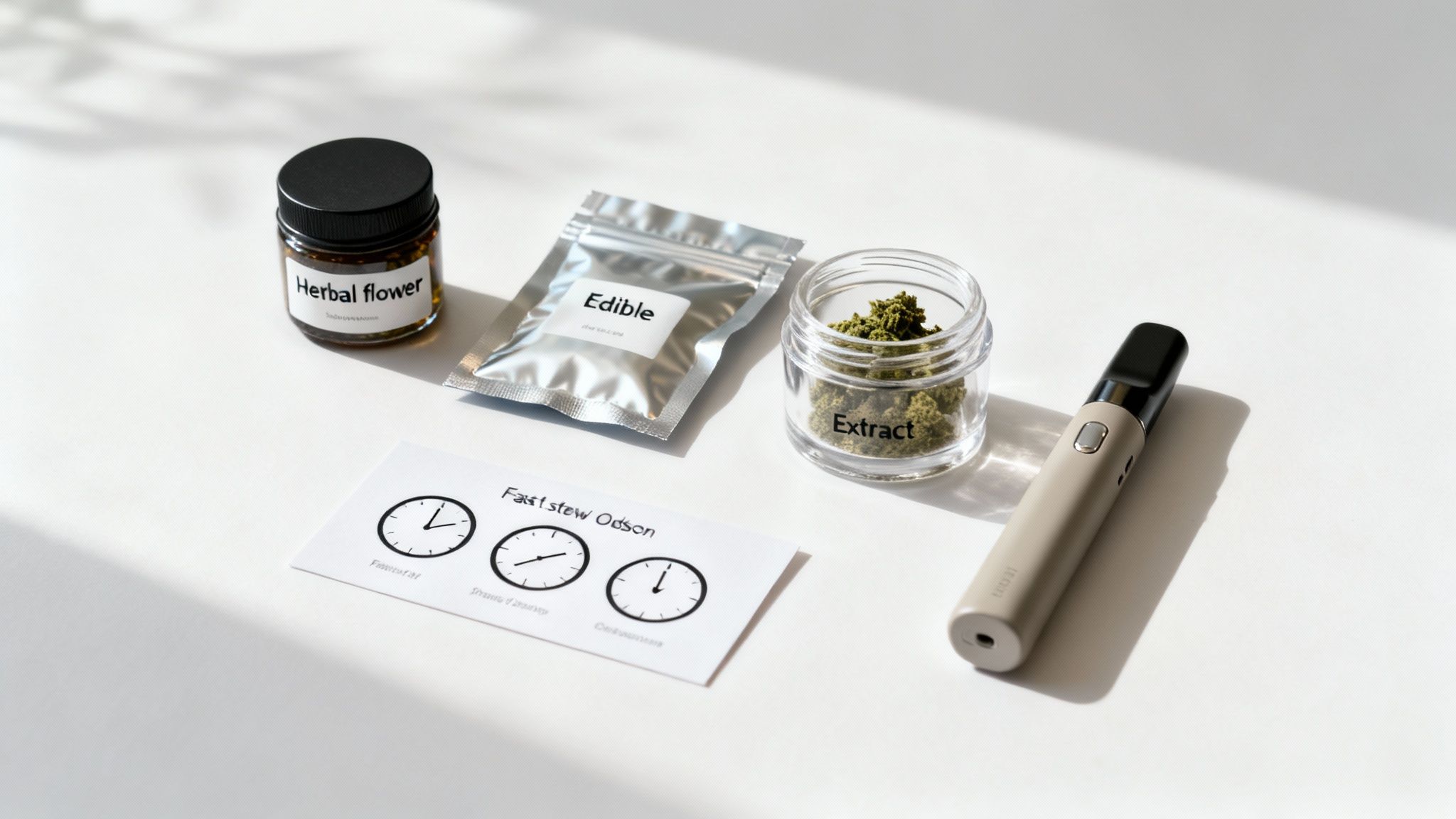
It’s not just about the strain. The way you choose to consume cannabis has a massive impact on your entire experience. Picking between smoking flower, hitting a vape, eating a gummy, or dabbing a concentrate is just as critical as selecting the right chemovar.
Each method changes how quickly you feel the effects, how long they stick around, and how intense the ride will be. Getting a handle on these differences is the secret to getting the predictable and positive results you're after.
For example, when you inhale cannabis—either by smoking a joint or using a vape—the good stuff gets into your bloodstream almost immediately. You’ll start feeling it within minutes. The trade-off? The effects tend to fade faster, usually lasting somewhere between one and three hours.
Edibles are a whole different ball game. They have to travel through your digestive system first, which means it can take anywhere from 30 minutes to two hours to kick in. Once they do, though, you’re in it for the long haul. The experience can easily last from four to eight hours, sometimes even longer.
A Quick Look at Different Formats
| Format | Onset Time | Duration | Intensity | Best For |
|---|---|---|---|---|
| Flower/Vape | 1-10 Minutes | 1-3 Hours | Immediate, easy to control | Quick effects and precise dose control |
| Edibles | 30-120 Minutes | 4-8+ Hours | Delayed, potent, long-lasting | Discreet, smoke-free, extended experience |
| Concentrates | 1-5 Minutes | 1-3 Hours | Very high, for experienced users | Maximum potency and rapid onset |
The way people consume cannabis is always evolving, and this variety is a huge part of the modern market. We're seeing some interesting shifts in what people prefer.
Research looking at products available to Ontario consumers three years post-legalization found that the market got stronger, fast. Most products for inhalation packed at least 20% THC. In that same period, people’s habits shifted: vape use jumped from 60% to 74%, while interest in traditional dried flower dropped from 65% to 49%. If you're curious, you can read more about these consumer trends and what they mean for the industry.
Potency, Products, and Making Smart Choices
This trend brings up a crucial point for everyone: today’s cannabis is generally much more potent than it used to be. No matter if you're reaching for an "indica," a "sativa," or a hybrid, always, always check the THC percentage and cannabinoid profile on the label before you buy.
Your consumption method and the product's potency are the two biggest variables you control. Choosing the right format for the occasion and starting with a low dose are the foundations of a safe and enjoyable experience.
In the end, what's "best" comes down to you, your goals, and your comfort level. Whether you love the immediate feedback from smoking or prefer the slow-and-steady journey of an edible, understanding how each format works is what puts you in the driver's seat.
Your Indica vs. Sativa Questions Answered
Diving into the world of cannabis can feel like learning a new language, especially when you find out the old rules don't quite fit anymore. Let's clear up some of the most common questions about indica vs. sativa effects, so you can feel confident in your choices.
If Indica and Sativa Labels Are Unreliable, What Should I Ask For?
Instead of walking in and asking for an "indica" or a "sativa," try describing the kind of experience you're hoping to have. When you tell a budtender what you want to feel, they can give you a much more accurate recommendation.
Think about what you're trying to achieve and frame your request around that. For example:
- "I'm looking for something to spark creativity and make me feel a bit more social for a weekend project."
- "I'd love a product that will help me unwind and just sink into the couch for a movie night."
This approach gives the staff a clear picture of your goal. They can then point you toward products with the right combination of cannabinoids and terpenes to get you there, which is far more reliable than just grabbing a bag with a specific label.
Are Hybrid Strains a Good Middle Ground?
Honestly, the term "hybrid" is just as murky as "indica" and "sativa." Pretty much all modern cannabis is technically a hybrid of some sort, so that label doesn't tell you much about how it will actually make you feel.
A strain labelled as a "hybrid" could lean in any direction—it all comes down to its unique chemical profile. The best bet is still to focus on the effects you want and let that guide you, rather than getting hung up on its classification.
Your own body chemistry, the dose you take, your environment, and even your mood are massive parts of the equation. While the plant's terpene and cannabinoid profile sets the stage, these other factors are just as crucial in shaping your final experience.
Why Do I Feel Sleepy From Some Sativas and Energized From Some Indicas?
This is the perfect real-world example of why those old labels just don't hold up. Your reaction wasn't to the "sativa" or "indica" classification, but to the specific chemical cocktail inside that particular product—its unique blend of THC, other cannabinoids, and terpenes.
This is exactly why we always tell people to start with a low dose when trying anything new. It's the only real way to learn how different chemovars affect your body and discover what truly works for you.
Ready to put the myths aside and find the perfect product for your next session? The team here at Cannabission Cannabis is ready to help. You can check out our hand-picked selection online or swing by the store for some friendly, personalized advice.
Article created using Outrank


